Current Issue
Archive
Online First
Instructions for Authors
Guide for Authors
Peer Review Policy
Research Ethics Policy
Crossmark Policy
Ghostwriting and Guest Authorship
Copyright
Open Access Policy
Plagiarism
About the Journal
Aim and Scope
Publisher
Editorial Board
Indexing in databases
Personal Data Protection
Repository Policy
AI Policy
Contact


ORIGINAL PAPER
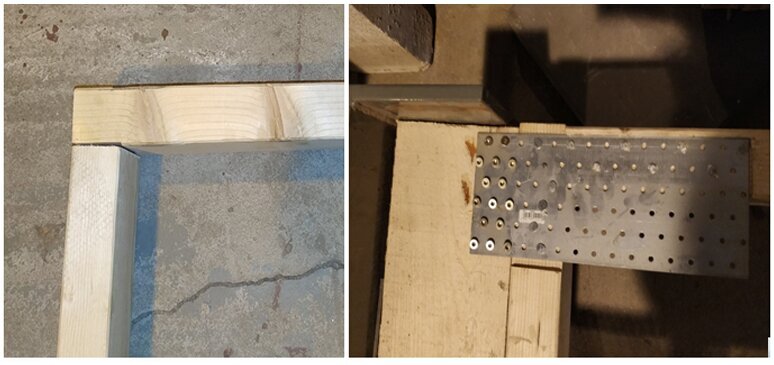
Effects of Different Types of Connections on the Dynamic Response of Wooden Frames - Experimental Study
1
Faculty of Civil and Environmental Engineering, Gdansk University of Technology, Poland
2
Multidisciplinary Center for Infrastructure Engineering, School of Architecture and Civil Engineering, Shenyang University of Technology, China
Submission date: 2025-09-09
Final revision date: 2026-01-16
Acceptance date: 2026-01-26
Online publication date: 2026-07-09
Publication date: 2026-07-28
Corresponding author
Mahmoud Miari
Faculty of Civil and Environmental Engineering, Gdansk University of Technology, Poland
Faculty of Civil and Environmental Engineering, Gdansk University of Technology, Poland
Drewno 2026;69(218)

KEYWORDS
TOPICS
ABSTRACT
Timber buildings are resistant to dynamic loads due to their low weight and relatively high rigidity. However, the connections between wooden elements are the key elements of their rigidity. This study investigates how two common fasteners—nails and screws—affect the dynamic response of wooden frames. Experimental tests have been conducted on two different wooden frames. The first one is connected with nails while the second one is connected with screws. Standard wall frame elements were subjected to harmonic excitation at various frequencies and displacement amplitudes. The research aimed to assess the impact of the typical structural fasteners used on the rigidity of the wooden frame in global terms. Experimental results indicate that replacing nails with screws significantly enhances the dynamic performance of wooden wall frames. The results show a very good and effective method of strengthening skeletal structures, which can be implemented at a low cost at the initial design and during the construction stage of the structures.
| eISSN: | 2956-9141 |

We process personal data collected when visiting the website. The function of obtaining information about users and their behavior is carried out by voluntarily entered information in forms and saving cookies in end devices. Data, including cookies, are used to provide services, improve the user experience and to analyze the traffic in accordance with the Privacy policy. Data are also collected and processed by Google Analytics tool (more).
You can change cookies settings in your browser. Restricted use of cookies in the browser configuration may affect some functionalities of the website.
You can change cookies settings in your browser. Restricted use of cookies in the browser configuration may affect some functionalities of the website.