Current Issue
Archive
Online First
Instructions for Authors
Guide for Authors
Peer Review Policy
Research Ethics Policy
Crossmark Policy
Ghostwriting and Guest Authorship
Copyright
Open Access Policy
Plagiarism
About the Journal
Aim and Scope
Publisher
Editorial Board
Indexing in databases
Personal Data Protection
Repository Policy
AI Policy
Contact


ORIGINAL PAPER
Price convergence in the primary regional timber market: evidence from a regional directorate of the State Forests
1
Department of Forest Resources Management, University of Agriculture in Kraków, Faculty of Forestry, Poland
Submission date: 2026-01-05
Final revision date: 2026-04-07
Acceptance date: 2026-04-10
Online publication date: 2026-09-17
Corresponding author
Anna Magdalena Kożuch
Department of Forest Resources Management, University of Agriculture in Kraków, Faculty of Forestry, aleja Mickiewicza 21, 21-120, Kraków, Poland
Department of Forest Resources Management, University of Agriculture in Kraków, Faculty of Forestry, aleja Mickiewicza 21, 21-120, Kraków, Poland

KEYWORDS
σ-convergenceβ-convergenceprice dispersionγ-convergencetimber sales policyforest districtsRDSF Katowice
TOPICS
ABSTRACT
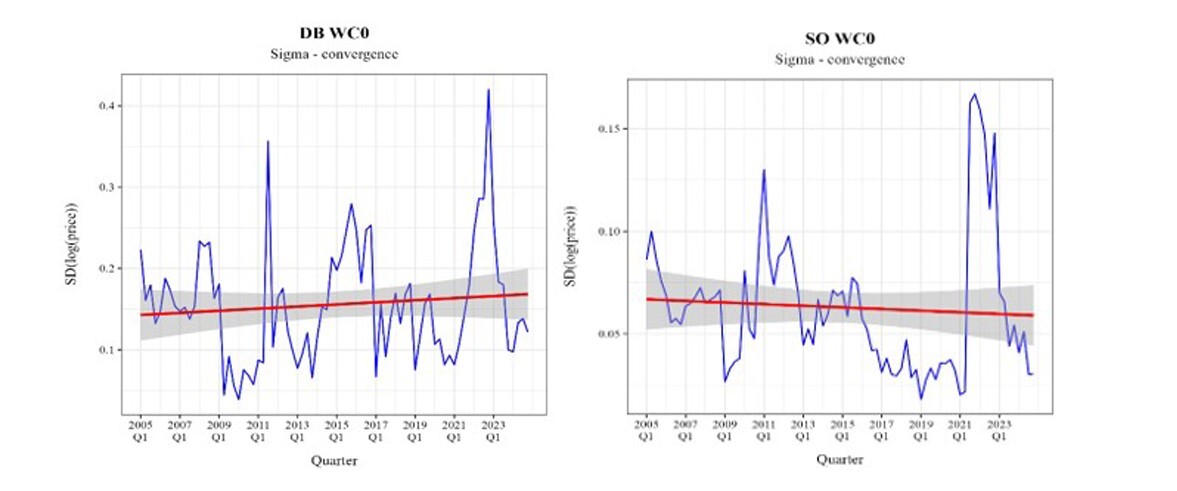
This study examines price convergence in the regional primary timber market in Poland. Although timber in the State Forests is sold under a unified institutional framework and standardized assortment classification, persistent spatial price differences remain. Understanding these mechanisms is important for improving the efficiency of the timber sales system and reducing revenue losses associated with spatial price disparities. The aim of the paper is to assess timber price convergence using forest districts of the Regional Directorate of the State Forests in Katowice as a case study. Quarterly nominal timber prices (PLN/m³, net) for 2005–2024 were analysed, focusing on economically important pine and oak assortments, particularly large-sized timber (WC03) and medium-sized timber (S2A). Three complementary measures of convergence were applied: β (price catching-up), σ (changes in price dispersion), and γ (changes in relative price rankings measured using Spearman’s rank correlation coefficient). The results indicate statistically significant β-convergence across all assortments, implying faster price growth in forest districts with lower initial price levels. However, no evidence of σ-convergence was found, as price dispersion did not decrease over time. The γ-convergence analysis revealed limited changes in price rankings, particularly for large-sized oak timber, indicating persistent relative price differences. The findings suggest that a unified sales system contributes to convergence in price dynamics but does not eliminate spatial price differences, which should be considered when formulating sales strategies to avoid pricing and revenue inefficiencies.
| eISSN: | 2956-9141 |

We process personal data collected when visiting the website. The function of obtaining information about users and their behavior is carried out by voluntarily entered information in forms and saving cookies in end devices. Data, including cookies, are used to provide services, improve the user experience and to analyze the traffic in accordance with the Privacy policy. Data are also collected and processed by Google Analytics tool (more).
You can change cookies settings in your browser. Restricted use of cookies in the browser configuration may affect some functionalities of the website.
You can change cookies settings in your browser. Restricted use of cookies in the browser configuration may affect some functionalities of the website.
