Current Issue
Archive
Online First
Instructions for Authors
Guide for Authors
Peer Review Policy
Research Ethics Policy
Crossmark Policy
Ghostwriting and Guest Authorship
Copyright
Open Access Policy
Plagiarism
About the Journal
Aim and Scope
Publisher
Editorial Board
Indexing in databases
Personal Data Protection
Repository Policy
AI Policy
Contact


ORIGINAL PAPER
Evaluation of Pine Wood Performance Following Multifunctional Compound Treatments
1
Industrial Engineering, Osmaniye Korkut Ata University, Turkey
2
Forest Industrial Engineering, Karadeniz Technical University, Turkey
Submission date: 2025-04-08
Final revision date: 2025-07-04
Acceptance date: 2025-07-11
Online publication date: 2026-04-14
Publication date: 2026-07-28
Drewno 2026;69(218)

KEYWORDS
TOPICS
ABSTRACT
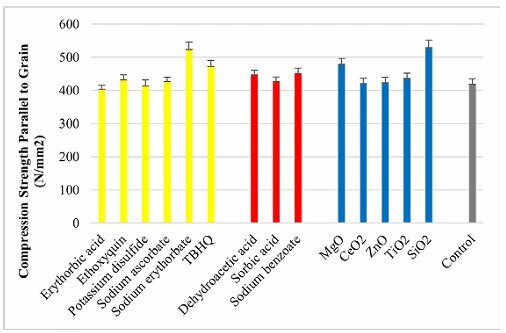
In this study, the usability of artificial antioxidants, nano oxides and generally regarded as safe (GRAS) compounds in the wood preservation industry was investigated. For this purpose, some physical, biological, mechanical properties and surface chemistry analysis of Scotch pine wood impregnated with 14 different compounds selected from these three different groups was performed. The physical changes in the impregnated samples were evaluated based on water absorption rate and water repellency. In addition, combustion behavior and color changes were examined to assess fire and surface optical/color properties, respectively. To investigate the biological properties of the impregnated wood samples, fungal decay resistance test was applied using Coniophera puteana fungus. To reveal the changes in the mechanical properties of wood compression strength parallel to grain test was applied. Limit oxygen index (LOI) test was conducted to investigate the combustion properties of the impregnated wood samples. To interpret the interaction of the impregnated samples with wood, surface chemistry analysis was carried out and Fourier Transform Infrared Spectroscopy (FTIR) test was performed. Scanning electron microscopy (SEM) analyses were performed to observe the distribution of impregnated samples in the wood. After all these tests it can be concluded that tested artificial antioxidants, nano oxides and GRAS compounds can be used as impregnation materials. Especially, nano-oxides exhibited good performance in many aspects. Therefore, it is recommended to examine nano-oxides more closely with other experimental variations. As a result, such multifunctional compounds could be promising protection alternatives with environmentally friendly characteristics to highly toxic biocides.
| eISSN: | 2956-9141 |

We process personal data collected when visiting the website. The function of obtaining information about users and their behavior is carried out by voluntarily entered information in forms and saving cookies in end devices. Data, including cookies, are used to provide services, improve the user experience and to analyze the traffic in accordance with the Privacy policy. Data are also collected and processed by Google Analytics tool (more).
You can change cookies settings in your browser. Restricted use of cookies in the browser configuration may affect some functionalities of the website.
You can change cookies settings in your browser. Restricted use of cookies in the browser configuration may affect some functionalities of the website.