Current Issue
Archive
Online First
Instructions for Authors
Guide for Authors
Peer Review Policy
Research Ethics Policy
Crossmark Policy
Ghostwriting and Guest Authorship
Copyright
Open Access Policy
Plagiarism
About the Journal
Aim and Scope
Publisher
Editorial Board
Indexing in databases
Personal Data Protection
Repository Policy
AI Policy
Contact


ORIGINAL PAPER
Experimental and Numerical Analysis of Screw Withdrawal Strength of Cross-Laminated Timbers

1
Forest Industry Engineering, Bursa Technical University, Turkey
Submission date: 2025-10-11
Final revision date: 2026-01-27
Acceptance date: 2026-02-09
Online publication date: 2026-09-23

KEYWORDS
TOPICS
ABSTRACT
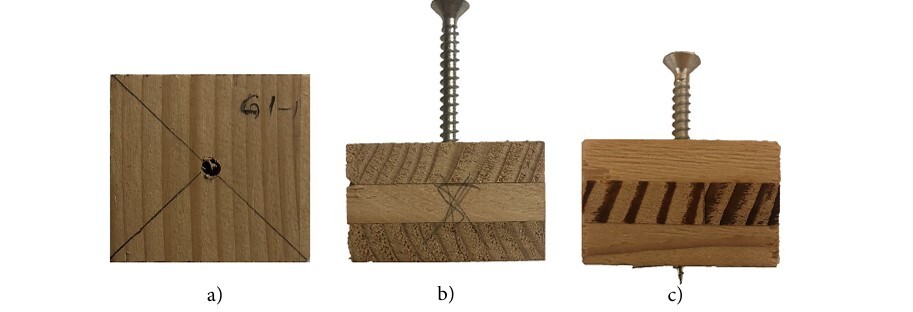
This study examines the impact of screw penetration depth and wood species on the SWS of CLT panels, utilizing a combination of experimental testing and FEA to assess performance. CLT panels were fabricated from Uludağ fir and black pine, and screw withdrawal tests were performed at two penetration depths corresponding to two- and three-layer. The average densities of CLTs were 0.44 g/cm3 for Uludağ fir and 0.52 g/cm3 for black pine, with respective moisture contents of 11.37% and 11.08%. The average SWS for Uludağ fir CLTs increased from 9.73 N/mm2 (two-layer) to 11.27 N/mm2 (three-layer), representing a 15.83% enhancement, while black pine CLTs improved from 13.85 N/mm2 to 14.72 N/mm2 (6.28% increase) with an increase in penetration depth from two to three-layer. Statistical analysis confirmed significant effects of both wood species and penetration depth. FEA simulations predicted withdrawal resistances of 2950.41–3115.94 N for Uludağ fir and 3339.19–3969.73 N for black pine, with two and three-layer penetration depths, respectively. The differences between the experimental and numerical results ranged from 3.69% to 50.10%. Approximately 62.50% of comparisons were within an acceptable 24% deviation range for wood materials. The results indicate that denser species and greater penetration depth enhance withdrawal performance, while FEA provides reasonably accurate yet conservative estimates. The developed experimental–numerical framework provides a reliable predictive basis for designing and optimizing screw connections in wooden constructions, contributing to safer, more efficient, and sustainable CLT-based building systems.
| eISSN: | 2956-9141 |

We process personal data collected when visiting the website. The function of obtaining information about users and their behavior is carried out by voluntarily entered information in forms and saving cookies in end devices. Data, including cookies, are used to provide services, improve the user experience and to analyze the traffic in accordance with the Privacy policy. Data are also collected and processed by Google Analytics tool (more).
You can change cookies settings in your browser. Restricted use of cookies in the browser configuration may affect some functionalities of the website.
You can change cookies settings in your browser. Restricted use of cookies in the browser configuration may affect some functionalities of the website.