Current Issue
Archive
Online First
Instructions for Authors
Guide for Authors
Peer Review Policy
Research Ethics Policy
Crossmark Policy
Ghostwriting and Guest Authorship
Copyright
Open Access Policy
Plagiarism
About the Journal
Aim and Scope
Publisher
Editorial Board
Indexing in databases
Personal Data Protection
Repository Policy
AI Policy
Contact


ORIGINAL PAPER
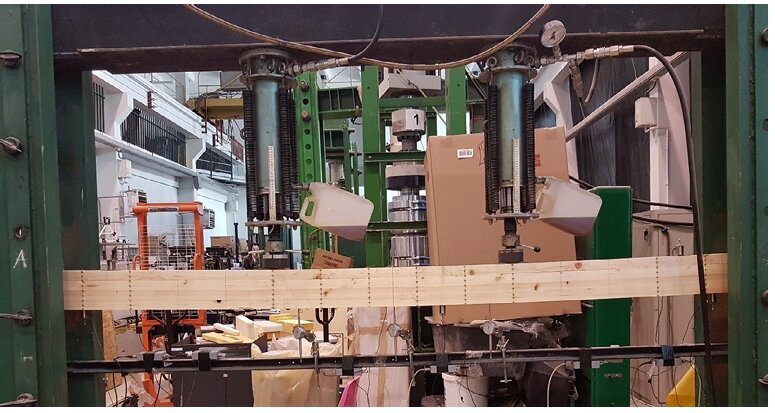
Behaviour of jute fibre-reinforced glued laminated timber beams under short-term and long-term loading

1
Department of Materials Strength and Structural Diagnostics, Kielce University of Technology, Poland
Submission date: 2026-01-17
Final revision date: 2026-03-05
Acceptance date: 2026-03-25
Online publication date: 2026-05-08
Publication date: 2026-07-28
Corresponding author
Agnieszka Wdowiak-Postulak
Department of Materials Strength and Structural Diagnostics, Kielce University of Technology, Al. Tysiąclecia Państwa Polskiego 7, 25-314, Kielce, Poland
Department of Materials Strength and Structural Diagnostics, Kielce University of Technology, Al. Tysiąclecia Państwa Polskiego 7, 25-314, Kielce, Poland
Drewno 2026;69(218)

KEYWORDS
TOPICS
ABSTRACT
It is important to note that the application of natural fiber–reinforced polymer (NFRP) composites has been increasing daily due to their significant benefits in civil engineering, the automotive, and aerospace industries, among others. Just like jute, they are ecological, renewable and completely or partially biodegradable. This allows them to contribute to the development of new high-performance polymer materials with excellent strength properties (e.g., tensile strength, flexural behavior, fracture toughness, and fracture resistance). Therefore, the results of experimental tests of glued beams reinforced with prestressed jute fiber rods and fabrics in bending and shear are discussed below. Twenty-four technical-scale wooden beams were used for four-point bending shear tests, each beam having a different reinforcement percentage. The study found that high performance was achieved with FRP jute reinforcement, with a single layer increasing load-bearing capacity by approximately 13 % and stiffness by approximately 12 %. A double layer provided even greater performance, by approximately 27% and 14 %, respectively. Moreover, in the case of unreinforced beams at mid-span the deflection under long-term load was 28 %, meanwhile approximately 35 % for a mid-span beam made of solid laminated timber with single jute reinforcement and approximately 36 % for a double jute reinforcement. Considering the numerical analysis, the differences between the experimental and numerical models were approximately 5 %, which provided satisfactory results for design prediction.
| eISSN: | 2956-9141 |

We process personal data collected when visiting the website. The function of obtaining information about users and their behavior is carried out by voluntarily entered information in forms and saving cookies in end devices. Data, including cookies, are used to provide services, improve the user experience and to analyze the traffic in accordance with the Privacy policy. Data are also collected and processed by Google Analytics tool (more).
You can change cookies settings in your browser. Restricted use of cookies in the browser configuration may affect some functionalities of the website.
You can change cookies settings in your browser. Restricted use of cookies in the browser configuration may affect some functionalities of the website.
