Current Issue
Archive
Online First
Instructions for Authors
Guide for Authors
Peer Review Policy
Research Ethics Policy
Crossmark Policy
Ghostwriting and Guest Authorship
Copyright
Open Access Policy
Plagiarism
About the Journal
Aim and Scope
Publisher
Editorial Board
Indexing in databases
Personal Data Protection
Repository Policy
AI Policy
Contact


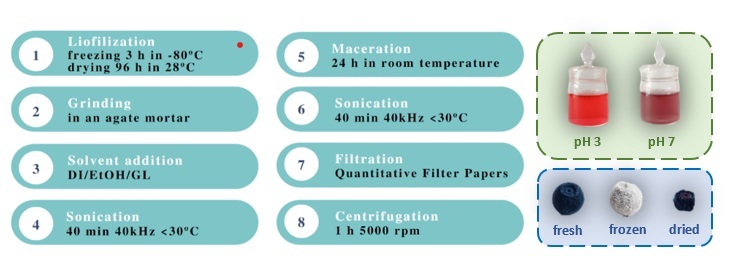
Color Photostability Assessment of Ultrasound-Assisted Extracts From European Blueberry (Vaccinium Myrtillus L.) Obtained with The Use of Non-Toxic Solvents
1
Łukasiewicz Research Network – Institute for Engineering of Polymer Materials and Dyes, Toruń, Poland
2
Doctoral School, Silesian University of Technology, Gliwice, Poland
3
Łukasiewicz Research Network – Institute of Non-Ferrous Metals, Gliwice, Poland
Online publication date: 2024-04-22
Drewno 2024;67(213)

KEYWORDS
European blueberry (Vaccin-ium myrtillus L.)ultrasound-assisted extractionnon-toxic solventsweathering testcolor photostabilitydyeing additives
REFERENCES (43)
1.
Al-Qahtani S.D., Alzahrani H.K., Azher O.A., Owidah, Z.O., Abualnaja M., Habeebullah T.M., El-Metwaly N.M. [2021]: Immobilization of anthocyanin-based red-cabbage extract onto cellulose fibers toward environmentally friendly biochromic diagnostic biosensor for recognition of urea. Journal of Environmental Chemical Engineering 9 [4]: 105493.
2.
Beć K.B., Grabska J., Ozaki Y., Hawranek J.P., Huck C.W. [2017]. Influence of Non-fundamental Modes on Mid-infrared Spectra: Anharmonic DFT Study of Aliphatic Ethers. The Journal of Physical Chemistry A 121 [7]: 1412–1424.
3.
Castañeda-Ovando A., Pacheco-Hernández M.L., Páez-Hernández M.E., Rodríguez J.A., Galán-Vidal C.A. [2009]: Chemical studies of anthocyanins: A review. Food Chemistry 113 [4]: 859–871.
4.
Căta A., Ştefănut M.N., Tănasie C., Pop R. [2010]: Comparative analysis of bilberries alcoholic extracts regarding to anthocyanins content, total phenolics and antioxidant activity. Ovidius University Annals of Chemistry 21 [1]: 15-–19.
5.
Chemat F., Rombaut N., Sicaire A.G., Meullemiestre A.; Fabiano-Tixier A.S., Abert-Vian M. [2016]: Ultrasound assisted extraction of food and natural products. Mechanisms, techniques, combinations, protocols, and applications A Review. Ultrasonics Sonochemistry 34: 540-–560.
6.
Coultate T., Blackburn, R.S. [2018]: Food colorants: their past, present and future. Coloration Technology 134 [3]: 165-–186.
7.
Ćujić N., Šavikin K., Janković T., Pljevljakušić D., Zdunić G., Ibrić S. [2016]: Optimization of polyphenols extraction from dried chokeberry using maceration as traditional technique. Food Chemistry 194: 135–142.
8.
El Kouari Y., Migalska-Zalas A., Arof A.K., Sahraoui, B. [2015]: Computations of absorption spectra and nonlinear optical properties of molecules based on anthocyanidin structure. Optical and Quantum Electronics 47 [5]: 1091–1099.
9.
Eyiz V., Tontul I., Turker, S. [2019]: Optimization of green extraction of phytochemicals from red grape pomace by homogenizer assisted extraction. Journal of Food Measurement and Characterization 14: 39-–47.
10.
Garzón G.A., Wrolstad R.E. [2001]: The stability of pelargonidin-based anthocyanins at varying water activity. Food Chemistry 75 [2]: 185–196.
11.
Haberhauer G., Rafferty B., Strebl F., Gerzabek M.H. [1998]: Comparison of the composition of forest soil litter derived from three different sites at various decompositional stages using FTIR spectroscopy. Geoderma 83: 331-–342.
12.
Halász K., Csóka L. [2018]: Black chokeberry (Aronia melanocarpa) pomace extract immobilized in chitosan for colorimetric pH indicator film application. Food Packaging and Shelf Life 16: 185-–193.
13.
He J., Giusti M.M. [2010]: Anthocyanins: Natural Colorants with Health-Promoting Properties. Annual Review of Food Science and Technology 1: 163–187.
14.
Kayesh E., Shangguan L., Korir K. N., Sun X., Bilkish N., Zhang Y., Han J., Song C., Cheng Z.-M., Fang J. [2013]: Fruit skin color and the role of anthocyanin. Acta Physiologiae Plantarum 35: 2879–2890.
15.
Kopyciński B., Duda A. [2022]: Anthocyanins – corrosion inhibitors straight from nature. Ochrona przed Korozją. 65 [7]: 216-–221.
16.
Kong J.M., Chia L.S., Goh N.K., Chia T.F., Brouillard R. [2003]: Analysis and biological activities of anthocyanin. Phytochemistry 64 [5]: 923-–933.
17.
Kowalska G., Wyrostek J., Kowalski R., Pankiewicz U. [2021]: Evaluation of glycerol usage for the extraction of anthocyanins from black chokeberry and elderberry fruits. Journal of Applied Research on Medicinal and Aromatic Plants 22: 105493.
18.
Lee J., Durst R.W., Wrolstad R.E. [2005]: Determination of Total Monomeric Anthocyanin Pigment Content of Fruit Juices, Beverages, Natural Colorants, and Wines by the pH Differential Method: Collaborative Study. Journal of AOAC International 88 [5]: 1269–1278.
19.
Liazid A., Guerrero R.F., Cantos E., Palma M., Barroso C.G. [2011]: Microwave assisted extraction of anthocyanins from grape skins. Food Chemistry 124 [3]: 1238–1243.
20.
Luchese C.L., Abdalla V.F., Spada J.C., Tessaro I.C. [2018]: Evaluation of blueberry residue incorporated cassava starch film as pH indicator in different simulants and foodstuffs. Food Hydrocolloids 82: 209-–218.
21.
Ma Q., Liang T., Cao L., Wang, L. [2017]: Intelligent poly (vinyl alcohol)-chitosan nanoparticles-mulberry extracts films capable of monitoring pH variations. International Journal of Biological Macromolecules 108: 576–-584.
22.
Mattioli R., Francioso A., Mosca L., Silva, P. [2020]: Anthocyanins: A Comprehensive Review of Their Chemical Properties and Health Effects on Cardiovascular and Neurodegenerative Diseases. Molecules 25 [17].
23.
Meissl K., Smidt E., Schwanninger M., Tintner J. [2008]: Determination of Humic Acids Content in Composts by Means of Near- and Mid-Infrared Spectroscopy and Partial Least Squares Regression Models. Applied Spectroscopy 62(8): 873–880.
24.
Michaelis L., Schubert M.P., Smythe C.V. [1936]: Potentiometric Study of the Flavins. Journal of Biological Chemistry 116(2): 587–607.
25.
Mohammadalinejhad S., Almasi H., Moradi M. [2020]: Immobilization of Echium amoenum anthocyanins into bacterial cellulose film: A novel colorimetric pH indicator for freshness/spoilage monitoring of shrimp. Food Control 113: 105493.
26.
Musso Y.S., Salgado P.R., Mauri A.N. [2018]: Smart gelatin films prepared using red cabbage (Brassica oleracea L.) extracts as solvent. Food Hydrocolloids 89: 674-681.
27.
Nopp-Mayr U., Zohmann-Neuberger M., Tintner J., Kriechbaum M., Rosenberger R., Nopp H., Bosa A., Smidt E. [2020]: From plants to feces: pilot applications of FTIR spectroscopy for studies on the foraging ecology of an avian herbivore. Journal of Ornithology 161: 203–215.
28.
Nour V., Stampar F., Veberic R., Jakopic J. [2013]: Anthocyanins profile, total phenolics and antioxidant activity of black currant ethanolic extracts as influenced by genotype and ethanol concentration. Food Chemistry 141 [2]: 961–966.
29.
Paes J., Dotta R., Barbero G.F., Martínez J. [2014]: Extraction of phenolic compounds and anthocyanins from blueberry (Vaccinium myrtillus L.) residues using supercritical CO2 and pressurized liquids. The Journal of Supercritical Fluids 95: 8–16.
30.
Phan K., Van Den Broeck E., Van Speybroeck V., De Clerck K., Raes K., De Meester S. [2020]: The potential of anthocyanins from blueberries as a natural dye for cotton: A combined experimental and theoretical study. Dyes and PigmentsS 176:108180.
31.
Puértolas E., Cregenzán O., Luengo E., Álvarez I., Raso, J. [2013]: Pulsed-electric-field-assisted extraction of anthocyanins from purple-fleshed potato. Food Chemistry 136: 1330–1336.
32.
Rumble J. R. (Ed.) [2018]: CRC Handbook of Chemistry and Physics, 99th Edition. CRC Press/Taylor & Francis.
33.
Salehi B., Sharifi-Rad J., Cappellini F., Reiner Z., Zorzan D., Imran M., Sener B., Kilic M., El-Shazly M., Fahmy N.M., Al-Sayed E., Martorell M., Tonelli C., Petroni K., Docea A.O., Calina D., Maroyi A. [2020]: The Therapeutic Potential of Anthocyanins: Current Approaches Based on Their Molecular Mechanism of Action. Frontiers in Pharmacology 11: 1300.
34.
Segur J. B., Oberstar H. E. [1951]: Viscosity of Glycerol and Its Aqueous Solutions. Industrial & Engineering Chemistry. 43 [9]: 2117–2120.
35.
Shehata E., Grigorakis S., Loupassaki S., Makris D.P. [2015]: Extraction optimisation using water/glycerol for the efficient recovery of polyphenolic antioxidants from two Artemisia species. Separation and Purification Technology 149: 462–469.
36.
Silva S., Costa E.M., Calhau C., Morais R.M., Pintado M.E. [2015]: Anthocyanin Extraction from Plant Tissues: A Review. Critical Reviews in Food Science and Nutrition 57 [14]: 3072–3083.
37.
Schwanninger M., Rodrigues J.C., Pereira H., Hinterstoisser B. [2004]: Effects of short-time vibratory ball milling on the shape of FT-IR spectra of wood and cellulose. Vibrational Spectroscopy 36 [1]: 23–40.
38.
Turturică M., Stănciuc N., Mureșan C., Râpeanu G., Croitoru C. [2018]: Thermal Degradation of Plum Anthocyanins: Comparison of Kinetics from Simple to Natural Systems. Journal of Food Quality 2018: 1–10.
39.
Quina F. H., Moreira P. F., Vautier-Giongo C., Rettori D., Rodrigues R. F., Freitas A. A., Silva P. F., Maçanita A. L. [2009]: Photochemistry of anthocyanins and their biological role in plant tissues. Pure and Applied Chemistry 81[9]: 1687–1694.
40.
Vankar P.S., Shukla D. [2011]: Natural dyeing with anthocyanins from Hibiscus rosa sinensis flowers. Journal of Applied Polymer Science 122 [5]: 3361-–3368.
41.
Wallace T.C., Giusti, M.M. [2019]: Anthocyanins – Nature’s Bold, Beautiful, and Health-Promoting Colors. Foods 8 [11]: 550.
42.
Wang H., Tang Z., Zhou W. [2016]: A method for dyeing cotton fabric with anthocyanin dyes extracted from mulberry (Morus rubra) fruits. Coloration Technology 132 [3]: 222–-231.
43.
Wu X., Beecher G.R., Holden J. M., Haytowitz D.B. Gebhardt, S.E., Prior R.L. [2006]: Concentrations of Anthocyanins in Common Foods in the United States and Estimation of Normal Consumption. Journal of Agricultural and Food Chemistry 54 [11]: 4069–407.
CITATIONS (1):
1.
Anthocyanin Enriched Sensitizer from Fruits of Blueberry in Photoanode of DSSC—an Extensive Experimental Analysis
Bagyalakshmi Shanmugam, Janarthanan Balasundaram, K. S. Radha, A. Dinesh, Chandrasekaran Joseph, Manikandan Ayyar, M. Santhamoorthy, S. Santhoshkumar, Abdullah M. S. Alhuthali, Alsharef Mohammad, Ayman A. Aly, M. Khalid Hossain
Brazilian Journal of Physics
Bagyalakshmi Shanmugam, Janarthanan Balasundaram, K. S. Radha, A. Dinesh, Chandrasekaran Joseph, Manikandan Ayyar, M. Santhamoorthy, S. Santhoshkumar, Abdullah M. S. Alhuthali, Alsharef Mohammad, Ayman A. Aly, M. Khalid Hossain
Brazilian Journal of Physics
| eISSN: | 2956-9141 |

We process personal data collected when visiting the website. The function of obtaining information about users and their behavior is carried out by voluntarily entered information in forms and saving cookies in end devices. Data, including cookies, are used to provide services, improve the user experience and to analyze the traffic in accordance with the Privacy policy. Data are also collected and processed by Google Analytics tool (more).
You can change cookies settings in your browser. Restricted use of cookies in the browser configuration may affect some functionalities of the website.
You can change cookies settings in your browser. Restricted use of cookies in the browser configuration may affect some functionalities of the website.
