Current Issue
Archive
Online First
Instructions for Authors
Guide for Authors
Peer Review Policy
Research Ethics Policy
Crossmark Policy
Ghostwriting and Guest Authorship
Copyright
Open Access Policy
Plagiarism
About the Journal
Aim and Scope
Publisher
Editorial Board
Indexing in databases
Personal Data Protection
Repository Policy
AI Policy
Contact


ORIGINAL PAPER
Physical Properties of Nearly Thousand-Year-Old Oak Wood Compared with Oak Wood of Different Origins from Previous Centuries and Present Times
1
Department of Forest Use, Engineering and Forest Technology, University of Agriculture in Krakow, Krakow, Poland
2
Department of Forest Ecosystem Protection, University of Agriculture in Krakow, Krakow, Poland
3
Department of Forest Resources Management, University of Agriculture in Krakow, Krakow, Poland
Submission date: 2025-03-11
Final revision date: 2025-07-14
Acceptance date: 2025-07-16
Online publication date: 2025-12-04
Publication date: 2026-03-19
Corresponding author
Bartłomiej Bednarz
Katedra Ochrony Ekosystemów Leśnych, Uniwersytet Rolniczy im. Hugona Kołłątaja w Krakowie, Aleja Mickiewicza 21, 31-120, Kraków, Poland
Katedra Ochrony Ekosystemów Leśnych, Uniwersytet Rolniczy im. Hugona Kołłątaja w Krakowie, Aleja Mickiewicza 21, 31-120, Kraków, Poland
Drewno 2026;69(217)

KEYWORDS
Quercus spradiocarbon datingwood compressive strengthsubfossil woodbogwoodwood hardnessdendrochronological dating
TOPICS
ABSTRACT
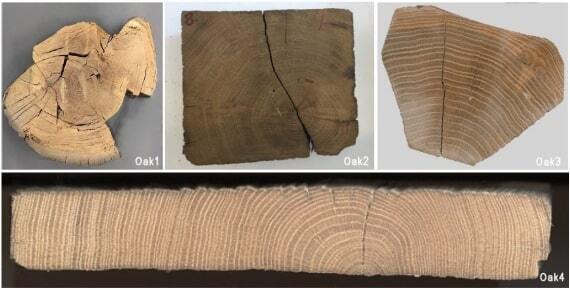
The aim of the study was to assess the hardness and compressive strength of oak wood from various historical contexts, and to compare these properties with modern oak wood. The study utilized both radiocarbon and dendrochronological dating to determine the age of the wood. A total of five oak wood fragments analyzed i.e. bog oak, oak wood from the bell tower of the Collegiate Basilica of the Holy Spirit in Przeworsk; oak wood from the scaffolding of the St. Nicholas Church in Gniew, wood from a dismantled granary in Drawsko Pomorskie and sample from a water dam in Czaniec. The dating confirmed that the oak fragments varied in age, ranging from several centuries to over 900 years. The mechanical tests using the Brinell method and compressive strength tests indicated that wood of bog oak displayed statistically significant differences in compressive strength compared to the other wood samples, which could be attributed to the long-term mineral saturation of the wood from prolonged exposure to anaerobic conditions in the bog. This mineralization likely caused a reduction in its elasticity and overall strength. In contrast, other samples, which had been exposed to varying environmental conditions like periodic water immersion or protection from moisture, did not show significant differences in mechanical tests. Despite these challenges, the findings suggest that compressive strength could serve as a useful indicator for estimating the age of oak wood in archaeological contexts, particularly for assessing the influence of long-term environmental conditions on wood properties.
CITATIONS (4):
1.
ВСТАНОВЛЕННЯ ВПЛИВУ ТИСКУ ПРЕСУВАННЯ ТА ТЕМПЕРАТУРИ ПРЕСУВАЛЬНОЇ МАТРИЦІ НА ПАРАМЕТР МІЦНОСТІ ПІД ЧАС СТИСКАННЯ ПАЛИВНИХ БРИКЕТІВ З ВІДХОДІВ ДЕРЕВИНИ ДУБА
Олександр Гасій, Іван Гончар, Юрій Шпуляр, Олег Кузін, Володимир Степанишин
Forestry, Forest, Paper and Woodworking Industry
Олександр Гасій, Іван Гончар, Юрій Шпуляр, Олег Кузін, Володимир Степанишин
Forestry, Forest, Paper and Woodworking Industry
2.
ЗАЛЕЖНІСТЬ ПОКАЗНИКА МІЦНОСТІ ЗРОЩЕНИХ ЗАГОТОВОК З ДЕРЕВИНИ ДУБА ВІД ДОВЖИНИ ЗУБЧАСТОГО ШИПА ТА ВОЛОГОСТІ ДЕРЕВИНИ
Юрій Козак, Андрій Кушпіт
Forestry, Forest, Paper and Woodworking Industry
Юрій Козак, Андрій Кушпіт
Forestry, Forest, Paper and Woodworking Industry
3.
ВИЗНАЧЕННЯ ВПЛИВУ ТОВЩИНИ ЛАМЕЛЕЙ ТА ВИТРАТИ КЛЕЮ НА ПАРАМЕТР МІЦНОСТІ ПІД ЧАС СКОЛЮВАННЯ ВЗДОВЖ ВОЛОКОН МЕБЛЕВИХ ЩИТІВ ІЗ ДЕРЕВИНИ БУКА
Тарас Подібка, Степан Грицак, Оксана Яріш, Наталія Чопенко, Роксолана Марунич
Forestry, Forest, Paper and Woodworking Industry
Тарас Подібка, Степан Грицак, Оксана Яріш, Наталія Чопенко, Роксолана Марунич
Forestry, Forest, Paper and Woodworking Industry
4.
РОЗРОБЛЕННЯ ПРІОРИТЕТНИХ НАПРЯМІВ РОЗВИТКУ МЕБЛЕВОЇ ГАЛУЗІ НА ОСНОВІ ТЕНДЕНЦІЙ ДЕРЕВООБРОБКИ
Сергій Гайда
Forestry, Forest, Paper and Woodworking Industry
Сергій Гайда
Forestry, Forest, Paper and Woodworking Industry
| eISSN: | 2956-9141 |

We process personal data collected when visiting the website. The function of obtaining information about users and their behavior is carried out by voluntarily entered information in forms and saving cookies in end devices. Data, including cookies, are used to provide services, improve the user experience and to analyze the traffic in accordance with the Privacy policy. Data are also collected and processed by Google Analytics tool (more).
You can change cookies settings in your browser. Restricted use of cookies in the browser configuration may affect some functionalities of the website.
You can change cookies settings in your browser. Restricted use of cookies in the browser configuration may affect some functionalities of the website.