Current Issue
Archive
Online First
Instructions for Authors
Guide for Authors
Peer Review Policy
Research Ethics Policy
Crossmark Policy
Ghostwriting and Guest Authorship
Copyright
Open Access Policy
Plagiarism
About the Journal
Aim and Scope
Publisher
Editorial Board
Indexing in databases
Personal Data Protection
Repository Policy
AI Policy
Contact


ORIGINAL PAPER
Investigation of frequency dependent electrical and dielectric properties of maple wood (acer trautvetteri medw.) with different surface treatments
1
Düzce University, Düzce Vocational School, Department of Electricity and Energy, Düzce/Türkiye., Turkey
Submission date: 2025-08-28
Final revision date: 2025-09-23
Acceptance date: 2025-09-25
Online publication date: 2025-12-17
Publication date: 2026-03-19
Corresponding author
Drewno 2026;69(217)

KEYWORDS
TOPICS
ABSTRACT
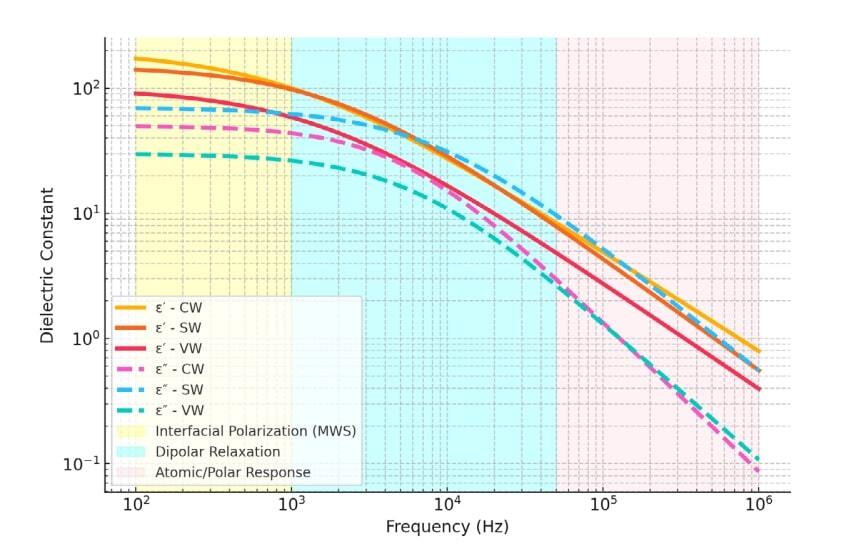
In this study, the electrical and dielectric properties of maple wood (Acer trautvetteri Medw.) were comprehensively investigated under three different surface conditions: untreated control (CW), two-week water immersion (SW), and double varnish (VW), as well as a function of frequency. For the accuracy of electrical analysis, all test samples were evaluated in dry state and comparative analysis was performed between surface treatment groups. In the experimental analyses in the frequency range from 100 Hz to 1 MHz, reel/imaginary part of dielectric permittivity (ε′ and ε″), dielectric loss factor (tanδ), alternating current electrical conductivity (σac), specific heat capacity (C), conductivity-dependent free energy component (G/ω), and real (Z′) and imaginary (Z″) impedance components were comprehensively evaluated. According to the test results, the SW test samples, with their high (ε′) and (ε″) values, were found to provide significant ionic and dipolar contributions. However, due to their high (tanδ) and (σac) values, their energy storage capacity is limited, and their conductivity potential is high. The VW test samples, with their low (ε″) and (tanδ) values, exhibit strong insulating properties, making them suitable for high-frequency capacitive applications. The CW test samples, in contrast, exhibit a balanced conductivity-insulation profile with moderate dielectric response. Impedance analyses (Z′, Z″) revealed that the low-resistance ion transport mechanism dominates in the SW test samples, while the surface coating creates a high-resistance barrier, thus limiting charge transport in the VW test samples.
| eISSN: | 2956-9141 |

We process personal data collected when visiting the website. The function of obtaining information about users and their behavior is carried out by voluntarily entered information in forms and saving cookies in end devices. Data, including cookies, are used to provide services, improve the user experience and to analyze the traffic in accordance with the Privacy policy. Data are also collected and processed by Google Analytics tool (more).
You can change cookies settings in your browser. Restricted use of cookies in the browser configuration may affect some functionalities of the website.
You can change cookies settings in your browser. Restricted use of cookies in the browser configuration may affect some functionalities of the website.
