Current Issue
Archive
Online First
Instructions for Authors
Guide for Authors
Peer Review Policy
Research Ethics Policy
Crossmark Policy
Ghostwriting and Guest Authorship
Copyright
Open Access Policy
Plagiarism
About the Journal
Aim and Scope
Publisher
Editorial Board
Indexing in databases
Personal Data Protection
Repository Policy
AI Policy
Contact


ORIGINAL PAPER
Natural durability of some wood species in ground contact at four sites in Turkey, part 2: the mechanical properties
1
Eastern Blacksea Forestry Research Institute, General Directorate of Forestry, Turkey
2
Forest Industry Engineering, Karadeniz Technical University, Turkey
Submission date: 2025-02-20
Final revision date: 2025-05-28
Acceptance date: 2025-05-30
Online publication date: 2025-12-19
Publication date: 2026-03-19
Corresponding author
Ceyhun Kiliç
Eastern Blacksea Forestry Research Institute, General Directorate of Forestry, Trabzon, Turkey
Eastern Blacksea Forestry Research Institute, General Directorate of Forestry, Trabzon, Turkey
Drewno 2026;69(217)

KEYWORDS
TOPICS
ABSTRACT
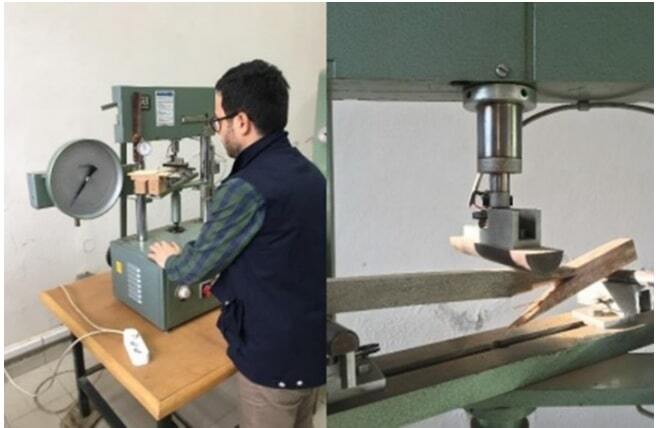
The first part of the study (Natural Durability of Some Wood Species in Ground Contact at Four Sites in Turkey Part 1: The Physical Properties) was published in the 67th volume of Drewno. This study involved the examination of heartwood, sapwood, and CCB (Copper Chromium Boron) impregnated sapwood samples from various tree species including Scots pine (Pinus sylvestris L), Caucasian spruce (Picea orientalis (L.) Peterm), European beech (Fagus orientalis L.) and common alder (Alnus glutinosa subsp. barbata), which had 20x20x300 mm dimensions. These samples were subjected to soil contact, specifically in hazard class 4 conditions as defined by EN 252 (2014), for a duration of 3 years. The study was conducted in four different provinces of Turkey, namely Trabzon, Muğla, Çanakkale, and Elazığ, each characterized by distinct climatic conditions. Bending strength, modulus of elasticity and compression strength of the samples collected back from test sites were examined. The highest bending strength, modulus of elasticity and the highest compression strength were observed in Elazığ (dry climate). In Çanakkale, Muğla and Trabzon (humid climate), relatively lower values were recorded. In terms of climate type, it can be said that Scots pine and Caucasian spruce wood samples have higher resistance than the European beech and common alder samples. Especially the heartwood of coniferous has been found to be more durable than the sapwood. In addition, no deformation was observed in any of the impregnated wood samples. The durability of all treated wood samples met the minimum requirements for (soil/outdoor/contact etc.).
Share
RELATED ARTICLE
| eISSN: | 2956-9141 |

We process personal data collected when visiting the website. The function of obtaining information about users and their behavior is carried out by voluntarily entered information in forms and saving cookies in end devices. Data, including cookies, are used to provide services, improve the user experience and to analyze the traffic in accordance with the Privacy policy. Data are also collected and processed by Google Analytics tool (more).
You can change cookies settings in your browser. Restricted use of cookies in the browser configuration may affect some functionalities of the website.
You can change cookies settings in your browser. Restricted use of cookies in the browser configuration may affect some functionalities of the website.
