Current Issue
Archive
Online First
Instructions for Authors
Guide for Authors
Peer Review Policy
Research Ethics Policy
Crossmark Policy
Ghostwriting and Guest Authorship
Copyright
Open Access Policy
Plagiarism
About the Journal
Aim and Scope
Publisher
Editorial Board
Indexing in databases
Personal Data Protection
Repository Policy
AI Policy
Contact


ORIGINAL PAPER
Natural Durability of Chestnut Wood in Soil Contact: A Comparative Study Across Different Climatic Regions of Türkiye
1
Eastern Blacksea Forestry Research Institute, General Directorate of Forestry, Turkey
2
Forest Industry Engineering, Karadeniz Technical University, Turkey
Submission date: 2025-05-14
Final revision date: 2025-07-30
Acceptance date: 2025-08-18
Online publication date: 2026-01-26
Publication date: 2026-03-19
Corresponding author
Ceyhun Kiliç
Eastern Blacksea Forestry Research Institute, General Directorate of Forestry, Trabzon, Turkey
Eastern Blacksea Forestry Research Institute, General Directorate of Forestry, Trabzon, Turkey
Drewno 2026;69(217)

KEYWORDS
TOPICS
ABSTRACT
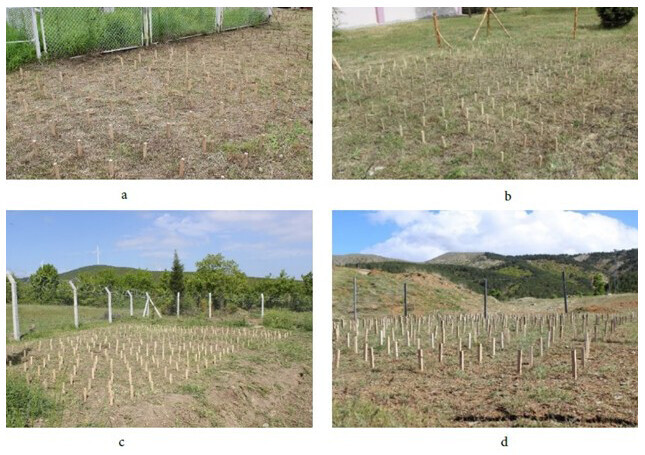
In this study, a total of 60 chestnut (Castanea sativa Mill.) wood samples were exposed to soil contact conditions for a period of three years in accordance with the EN252 standard. The tests were conducted in four provinces of Türkiye-Trabzon, Muğla, Çanakkale, and Elazığ-representing the Blacksea, Mediterranean, mixed, and terrestrial climate zones, respectively, in order to assess the natural durability of the wood under different environmental conditions. Climatic indices, soil characteristics, visual decay, mass loss, density, bending strength, modulus of elasticity, compressive strength, and color change were investigated. Among the four locations, the lowest average visual decay rating was observed in chestnut wood Elazığ (1.0), while the highest was recorded in this species of wood in Çanakkale (3.6). Similarly, the greatest weight loss occurred tested wood in Çanakkale, reaching 35.96%, whereas wood in Elazığ exhibited the least mass loss at 4.71%. Regarding density, wood in Elazığ presented the highest value at 0.54 g/cm³, whereas wood in Çanakkale showed the lowest at 0.39 g/cm³. The highest bending strength was wood in Elazığ at 71.73 N/mm2, the lowest was wood in Çanakkale at 38.28 N/mm2. The highest elastic modulus was wood in Elazığ at 5965.89 N/mm2, the lowest was wood in Çanakkale at 3855.42 N/mm². The highest compressive strength parallel to fibers (underground and aboveground) was wood in Elazığ at 48.25 N/mm² and 50.87 N/mm², respectively; the lowest was wood in Çanakkale, 13.51 N/mm² and 40.59 N/mm², respectively. The most significant color change was observed in the chestnut wood in Trabzon.
Share
RELATED ARTICLE
| eISSN: | 2956-9141 |

We process personal data collected when visiting the website. The function of obtaining information about users and their behavior is carried out by voluntarily entered information in forms and saving cookies in end devices. Data, including cookies, are used to provide services, improve the user experience and to analyze the traffic in accordance with the Privacy policy. Data are also collected and processed by Google Analytics tool (more).
You can change cookies settings in your browser. Restricted use of cookies in the browser configuration may affect some functionalities of the website.
You can change cookies settings in your browser. Restricted use of cookies in the browser configuration may affect some functionalities of the website.
