Current Issue
Archive
Online First
Instructions for Authors
Guide for Authors
Peer Review Policy
Research Ethics Policy
Crossmark Policy
Ghostwriting and Guest Authorship
Copyright
Open Access Policy
Plagiarism
About the Journal
Aim and Scope
Publisher
Editorial Board
Indexing in databases
Personal Data Protection
Repository Policy
AI Policy
Contact


ORIGINAL PAPER
Microscopic damage mechanism of Chinese fir subjected to environmental aging consisting of ultraviolet irradiation, thermal-humidity cycling, and salt fog
1
School of Resources Engineering, Xi'an University of Architecture & Technology, Xi'an, Shaanxi 710055, China
2
State Key Laboratory of Tropic Ocean Engineering Materials and Materials Evaluation, Hainan University, Haikou 570228, China
3
State Key Laboratory of Safety and Resilience of Civil Engineering in Mountain Area, East China Jiao Tong University, Nanchang 330013, China
Submission date: 2025-08-19
Final revision date: 2025-10-15
Acceptance date: 2025-11-03
Online publication date: 2026-01-12
Publication date: 2026-03-19
Corresponding author
Drewno 2026;69(217)

KEYWORDS
TOPICS
ABSTRACT
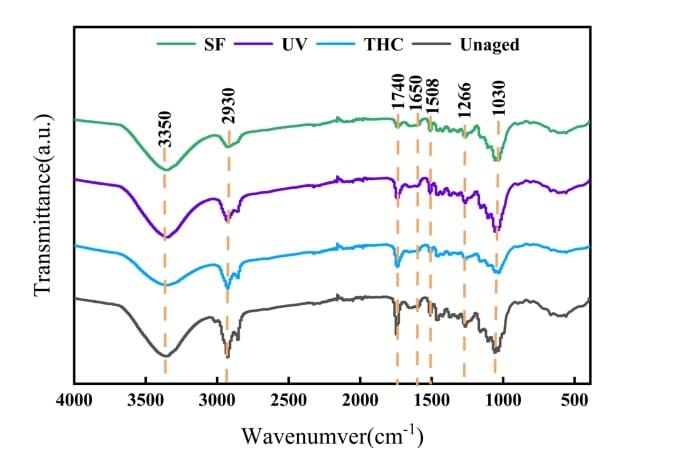
As a cornerstone structural material in Chinese architectural heritage, understanding the long-term durability of Chinese fir (Cunninghamia lanceolata) is critical for its preservation. This study comparatively investigates the degradation of Chinese fir under three accelerated aging protocols simulating key environmental threats: ultraviolet (UV) weathering, thermal-humidity cycling, and salt fog. The results revealed distinct degradation mechanisms with significant implications for heritage diagnostics. Salt fog exposure induced the most severe degradation, causing a 63.9% loss in bending strength through comprehensive chemical attacks. UV weathering led to significant surface photodegradation and microcracking, while thermal-humidity cycling caused a 46.5% reduction in bending strength, primarily due to physical stresses. Crucially, a strong, universal correlation was established between cellulose crystallinity (CrI) and the mechanical properties (tensile, R = 0.874; compressive, R = 0.902; bending, R = 0.941) across all aging conditions. This identifies CrI as a robust and minimally invasive indicator for assessing the mechanical integrity of historic timbers. Furthermore, the degradation kinetics under each stressor followed highly predictable linear trends (R² > 0.89), providing a quantitative basis for developing targeted conservation strategies and more accurate service life prediction models for timber heritage structures.
| eISSN: | 2956-9141 |

We process personal data collected when visiting the website. The function of obtaining information about users and their behavior is carried out by voluntarily entered information in forms and saving cookies in end devices. Data, including cookies, are used to provide services, improve the user experience and to analyze the traffic in accordance with the Privacy policy. Data are also collected and processed by Google Analytics tool (more).
You can change cookies settings in your browser. Restricted use of cookies in the browser configuration may affect some functionalities of the website.
You can change cookies settings in your browser. Restricted use of cookies in the browser configuration may affect some functionalities of the website.